
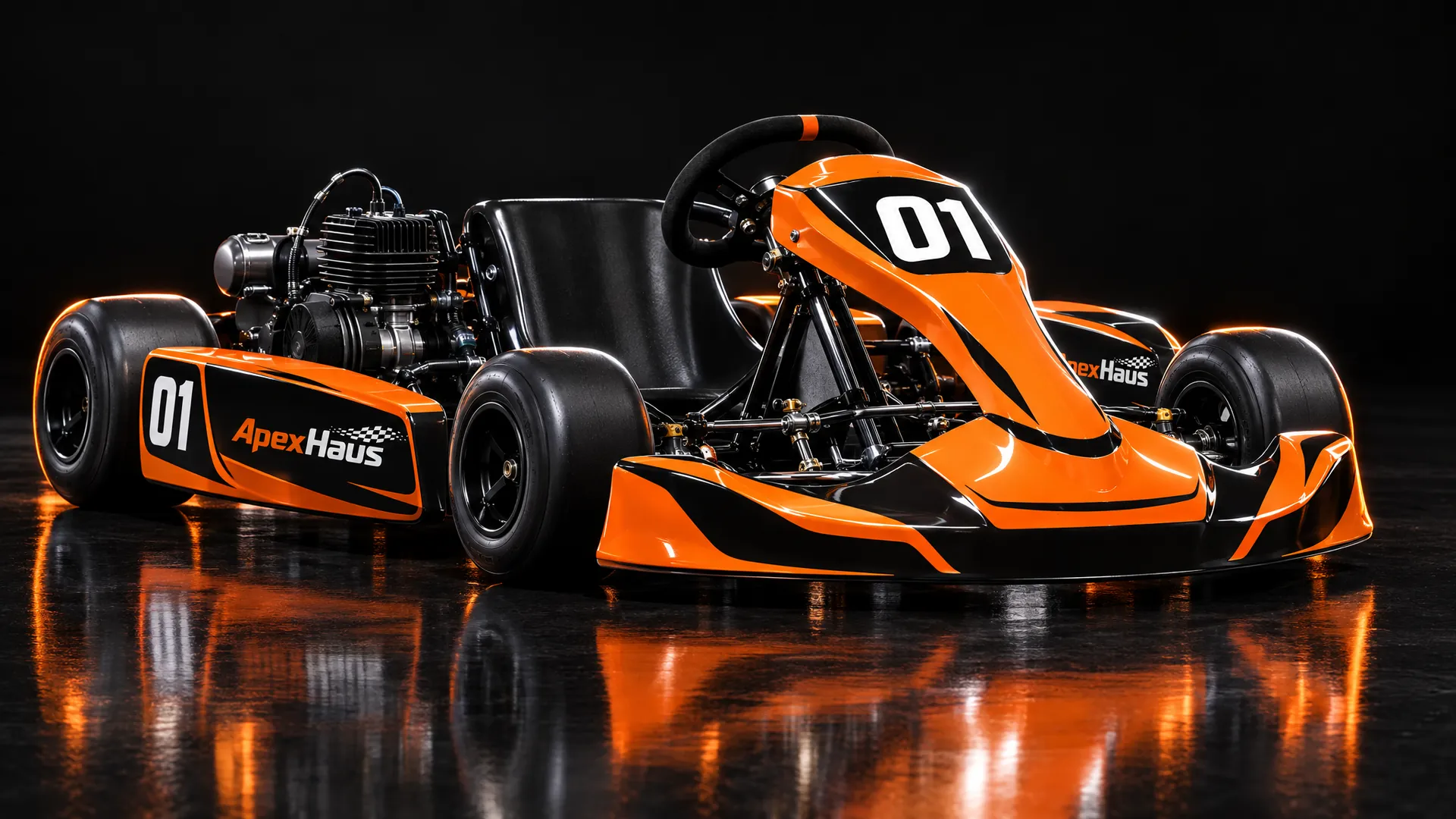
Ultimate performance electric karts.
ApexHaus karts · driver tier 03
We take a real, standard racing chassis - everything included, from the wheels, steering wheel and seat to the brakes and equipment, from any manufacturer, Tony Kart included - and put an electric power unit where the petrol engine used to be.
And it is not just an electric motor. It is a power unit that is superior in everything: horsepower, torque, ease of use, convenience.
COPY TBD (founder)Founder's message (spec §10), point by point. He writes the final copy: «Для новой категории думаем и разрабатываем».01Not a rental e-kart
Ask anyone who loves karting: electric karts are a joke. Not ours.
Many karting tracks, indoor ones included, now run electric karts. In 99% of them it is a cheap electric kart, or one built for the venue rather than for racing: minimum sport, minimum excitement. A “lite” version - not a sporting, racing kart, but an electric ride-on not far from a toy car.
Karts at those tracks
The electric golf cart.
Built for crowded rental tracks: light on sport, light on speed.
ApexHaus electric
The Tesla Plaid.
A real racing chassis and an electric power unit that out-pulls the petrol engine it replaces.
02Superior in everything
Not just an electric motor. Better in every way.
- 01
Horsepower
Up to 44 hp on the top published power unit, against ≈ 30 hp for a 125cc TaG senior engine. - 02
Torque
Up to 119 Nm at the motor, against 19.5–21 Nm at the petrol crank (different gearing; see the table). - 03
Ease of use
No fuel, no two-stroke oil. A battery swap takes about 2 minutes. - 04
Convenience
About 30 minutes on the fast charger (20–90 %), per the manufacturer.
Figures: manufacturer data, sources under the comparison table.
03Silence
Hear the tyres. Find the lap.
And most important: an electric power unit makes no engine noise. So the driver hears the tyres grip - and with every lap, improves the result again and again. That is remarkable.
04Petrol vs electric
Same chassis. Different heart.
Published manufacturer figures only. Where a number isn't published, it says TBD.
- Chassis
- PetrolStandard racing kart chassisElectricSame standard racing chassis. The power unit is described as compatible with any racing kart chassis (Birel ART, OTK, CRG, SODI, IPK and others).1
- Power
- Petrol≈ 30 hp (22 kW), 125cc TaG senior enginesElectricUp to 33 kW (44 hp), top published power unit2,3,1
- Torque
- Petrol19.5–21 Nm at the crankElectricUp to 119 Nm at the motor (different gearing, not a like-for-like figure)2,3,1
- Acceleration
- PetrolNot published by the engine makersElectric0–100 km/h in ~3.0 s (complete X5 kart, manufacturer figure)4
- Noise
- PetrolEngine noise: CIK-FIA dynamic limit 108 dBElectricNo combustion engine. dB figure not published: TBD5
- Energy
- PetrolFuel and two-stroke oilElectric96 V Li-Ion battery (5.3 kWh on the top kart); swap in about 2 min4,1
- Charging
- Petrol–ElectricAbout 30 min (20–90 %) with the 96 V fast charger, per manufacturer6
- Session length
- PetrolTank-dependentElectric10+ min per session, 60+ min per day (top unit, manufacturer figure)1
- ApexHaus fleet spec
- PetrolTaG karts: see ExperienceElectricPower unit, fleet size and access rules per location: TBD
- 1 Blue Shock Race: power units · accessed Oct 7, 2026
- 2 IAME: X30 Senior · accessed Oct 7, 2026
- 3 Rotax: 125 Senior MAX evo datasheet · accessed Oct 7, 2026
- 4 Blue Shock Race: racing karts · accessed Oct 7, 2026
- 5 FIA: noise limitation in karting · accessed Oct 7, 2026
- 6 Blue Shock Race: battery packs · accessed Oct 7, 2026
Electric power units by Blue Shock Race.
Three karts. Three driver tiers.